
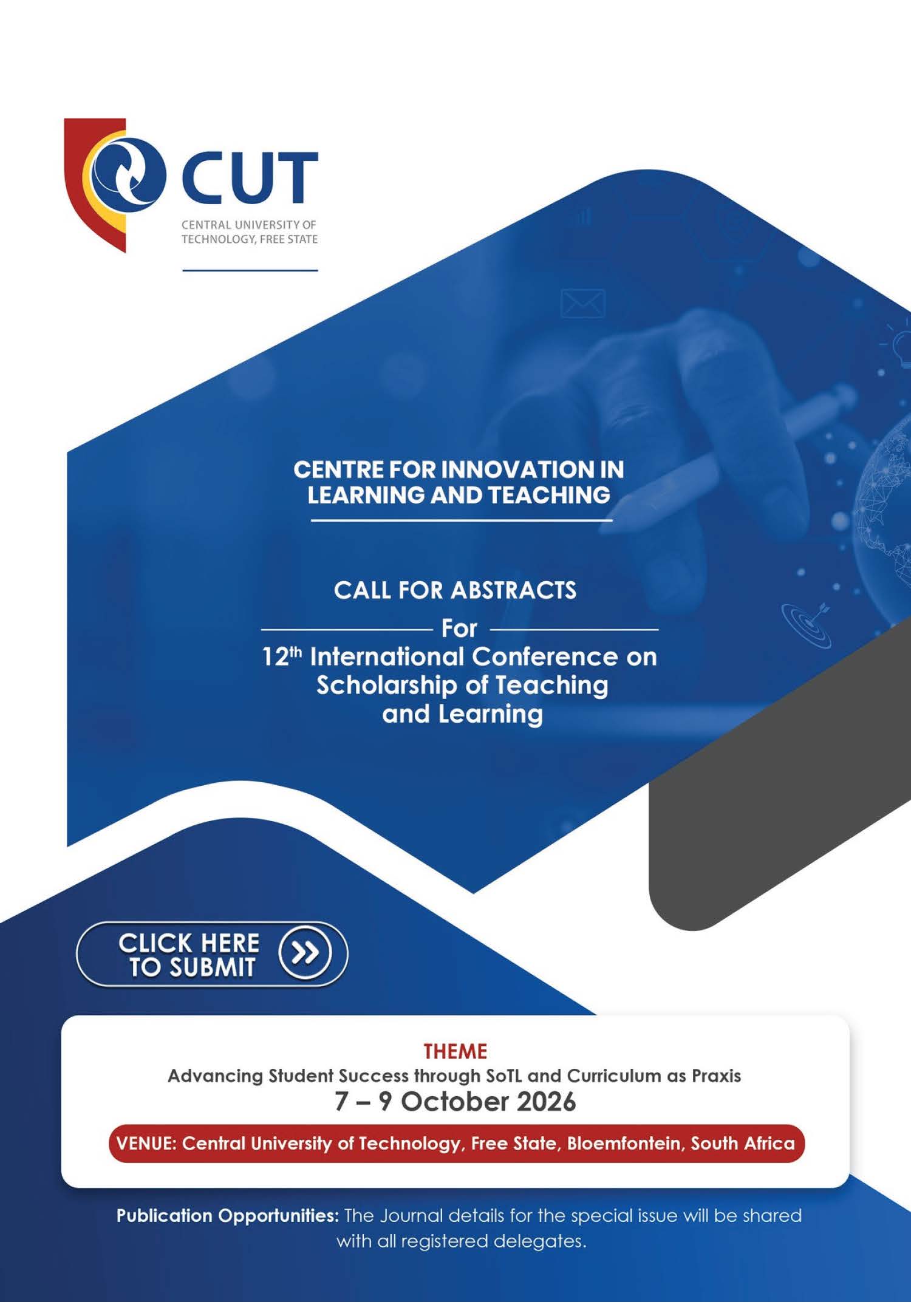
12th International Conference on Scholarship of Teaching and Learning (SoTL)
Advancing Student Success through SoTL and Curriculum as Praxis
The Central University of Technology, Free State (CUT), South Africa, invites scholars, academic developers, postgraduate researchers, and higher education leaders to submit contributions to the 12th International Conference on the Scholarship of Teaching and Learning (SoTL). The conference theme, Advancing Student Success through SoTL and Curriculum as Praxis, positions SoTL as a rigorous, evidence-informed vehicle for enhancing learning through curriculum renewal, purposeful pedagogy, and context-responsive educational innovation. SoTL’s distinctive contribution lies in making teaching and learning public, transparent, and improvable through theoretically grounded inquiry that is both disciplinary and interdisciplinary. A coherent conceptualisation of SoTL is therefore essential to strengthen the quality, communicability, and impact of scholarly teaching investigations across diverse fields (Miller-Young & Yeo, 2015). Within this frame, curriculum as praxis emphasises curriculum as lived, enacted, and continually reworked through reflective action that links what is valued, what is taught, how learning is supported, and how success is interpreted in real institutional contexts.
Download the Call for Papers
Download the Call for Full Papers (PDF) | 04 August 2026
Download the Call for Papers - special issue (PDF) | 27 May 2026
Abstract
Download the Call for Abstracts (PDF) | 13 August 2026
Student success is not produced by curriculum structure or teaching technique alone but emerges through an educational interface in which institutional conditions, learning design, relationships, student identities, and academic emotions interact to shape engagement and achievement (Kahu & Nelson, 2018). This conference foregrounds the value of SoTL as a rigorous way of making these interacting mechanisms visible and improvable, particularly when curriculum is approached as praxis rather than as a static plan. Framing curriculum as praxis strengthens the link between theory, evidence, and reflective action, enabling institutions to design learning pathways that cultivate belonging, academic momentum, and meaningful learning. In this sense, the conference advances a SoTL agenda that moves beyond generic claims about “what works” to develop transferable principles, context-sensitive evidence, and actionable implications for module, programme, and institutional improvement.
Assessment for learning and feedback are positioned as central levers in this praxis-oriented approach because they powerfully shape what counts as knowledge, how standards are interpreted, and how students regulate their learning over time. Throughout the learning process, students are formatively assessed to give them and their lecturers information that promotes better learning and student growth. The importance of this focus is amplified by the recognition that feedback only becomes educationally valuable when students can interpret, evaluate, and use it to improve future work. Strengthening student feedback literacy is therefore integral to advancing student success, as it supports learners’ capacity to engage productively with evaluative information and to develop agency and judgement in their learning (Carless & Boud, 2018). By elevating assessment and feedback as curriculum, the conference highlights how SoTL can reconfigure assessment practices to support progression, deepen learning, and build sustainable learning capabilities.
The conference also treats AI-enabled teaching and learning as a pedagogical and curricular question that requires scholarly scrutiny rather than instrumental adoption. While AI tools are rapidly entering educational spaces, systematic evidence suggests that research in this area has often been technology-driven, underlining the need to reconnect AI applications to educator perspectives, robust pedagogy, and ethical considerations (Zawacki-Richter et al., 2019). A SoTL lens is essential here because it anchors AI adoption in evidence, values, and educational purpose, and it supports principled approaches to curriculum design, learning activities, assessment practices, feedback processes, academic integrity, and student support. In doing so, the conference frames AI not as a substitute for teaching expertise, but as a site for scholarly inquiry into how learning can be enhanced in equitable, transparent, and human-centred ways.
Conclusively, the theme ‘Advancing Student Success through SoTL and Curriculum as Praxis’ explicitly connects student success to decolonising and diversifying learning, recognising that epistemic access and belonging depend on whose knowledge is legitimised, whose languages are valued, and which identities are recognised in curriculum and pedagogy. Decolonising the university requires confronting the politics of knowledge and the institutional conditions that shape what can be taught and learned (Mbembe, 2016). From a complementary perspective, SoTL framed through social justice insists that scholarly teaching must attend to equity, recognition, and participation, not only to effectiveness in the abstract (Leibowitz & Bozalek, 2016). Through bringing these concerns into conversation with curriculum as praxis, the conference positions SoTL as a vehicle for transforming learning environments so that student success is advanced through inclusive, context-responsive, and socially just curriculum and pedagogy.
Submissions are invited under the following sub-themes:
- SoTL and Curriculum Renewal: Exploring how scholarly inquiry informs curriculum transformation, coherence, alignment, and responsiveness to diverse student needs.
- High Impact Pedagogy: Investigating evidence-informed teaching strategies that promote deep learning, engagement, belonging, and academic momentum.
- Assessment for Learning: Reframing assessment and feedback as curriculum practices that develop feedback literacy, agency, and sustainable learning capabilities.
- Student Success Pathways: Examining institutional, programmatic, and classroom-level interventions that strengthen retention, progression, and epistemic access.
- AI Enabled Teaching and Learning: Critically exploring AI integration through a SoTL lens, including pedagogy, assessment, AI ethics, governance and policy.
- Decolonise and Diversify Learning: Interrogating curriculum, pedagogy, and assessment practices to advance epistemic justice, inclusion, and socially just student success.
We welcome research papers, reflective practice papers and posters that clearly articulate a teaching and learning problem, situate it within relevant theory, present appropriate evidence, and offer implications for curriculum and pedagogy that advance student success in diverse higher education contexts. Please contact the SoTL office if you would like to conduct a workshop during the conference.
Submissions
| Deadlines | Dates |
| Call for Abstracts | 15 March 2026 |
| Closing date for Abstract | 09 May 2026 |
| Notification for Accepted Abstracts | 17 – 20 June 2026 |
| Registration closing date | 15 August 2026 |
| Conference Dates | 7 - 9 October 2026 |
| Full Papers for Special Issue | 20 October 2026 |
Conference Registration Fee
| Category | Physical Attendance | Online Attendance |
| Academic Staff / Professionals | R3750 | R1500 |
| Postgraduate Students (Full-time or Part-time) | R1500 | R1500 |
Travel: where to stay, sightseeing

Communication Logistics
For any inquiries, please contact Ms Dineo Mopeli sotlconference@cut.ac.za


