
News Articles
Years of investment in Additive Manufacturing are paying off for CUT
Engineering, Built Environment and Information Technology
CRPM
Partnerships
CUT News
Leadership

Ms Naledi Pandor, the Minister of Science and Technology will launch the Research Chair on 14th August 2015 at Central University of Technology, Free State (CUT) which was awarded by the National Research Fund (NRF) under the Department of Science and Technology (DST) through the South African Research Chairs Initiative (SARChi).
This Research Chair, under the leadership of Prof Ihar Yadroitsau, SARChi Research Chair at CUT, is awarded in recognition of the phenomenal work that CUT is doing in this dynamic and exciting field. NRF and the Department have demonstrated consistent and on-going support for the research agenda within academic institutions through the SARChi Initiative. The goal of this initiative is to increase the research output and innovation from South Africans in areas that are considered essential to the country’s strategic growth and development. CUT has equally been committed to these goals, driving the creation of new and insightful methodologies within the AM space for many years. The CRPM is engaged with the overarching strategies as outlined by DST and NRF and this has led to rich and dynamic partnerships. The centre uses Rapid Prototyping, Rapid Manufacturing, Rapid Tooling and Medical Product Development technologies to further education, understanding and development within this space. SARChi Chairs are highly competitive initiatives that have all South African universities and research agencies for the chance to take part. They are tenable at universities and research agencies that are deemed by DST to be leaders in selected field. The hosting of this Research Chair by CUT is another achievement to add to its growing list. It will run for a period of five years and will enable CUT to create new platforms through AM and open up new ideas that come with this technology. 3D printing is set to play a fundamental role in the new industrial revolution, especially within the medical space where innovation can potentially transform people’s lives and CUT is at the cutting edge. “I am particularly pleased that CUT is proudly taking a lead in innovations that will change the face of medical science in South Africa. The Centre for Rapid Prototyping and Manufacturing (CRPM) continues with its ground-breaking work on the design, development and manufacturing of medical devices, and has assisted 12 patients to date. This is the first medical device of its kind in the country, and CRPM makes us stand proud at the forefront of innovation in this field,” said Prof. Thandwa Mthembu, Vice-Chancellor and Principal at CUT.
The SARChI Research Chair will focus on Medical Product Development through Additive Manufacturing (AM), also known as 3D printing, and many members of the medical profession have shown keen interest in the work that the CRPM has been doing. The centre’s capabilities in the design and manufacture of patient-specific implants has undergone impressive strides and its goal is to further this arena significantly, forming deeper alliances with medical professionals, public and private hospitals. “We are also focusing on contributing to medical equipment development through the design of innovative devices and production through new AM techniques in combination with conventional machining techniques,” says Prof Yadroitsau, “AM makes designs possible that conventional methods could not achieve so we are going to definitely look into medical equipment development under this research objective with an emphasis on patients with disabilities assistive devices.” It is thanks to the many years of hard work put in by CRPM that led to the Research Chair being awarded to CUT. The centre’s commitment to leading AM in the higher education sector in Africa and the pivotal role it is currently playing in the medical field have ensured that the SARChi Chair is in great hands.
Some of the case studies: Fig 1
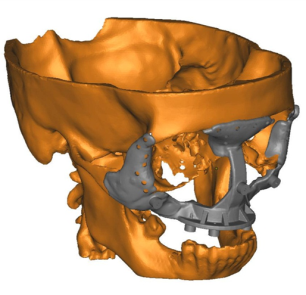
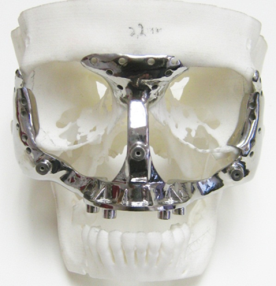
A female patient presented with cancer of themaxilla necessitating the entire area to be removed (Fig a). Prosthesis was designed from Computer Tomography (CT) images of the patient using specialized Magics® software (Fig 1b). The prosthesis was manufactured (Fig b) in titanium (Ti6Al4V) at the CRPM by means of the Direct Metal Laser Sintering (DMLS) process on an EOSINT M280 machine. A nylon drill guide was also manufactured through 3D printing in order to aid the surgeons in drilling guide holes in the patient’s scull for attaching the prosthesis using surgical screws. The titanium implant was cleaned and sterilized by Southern Implants. Fig 2:
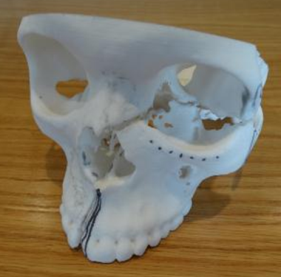
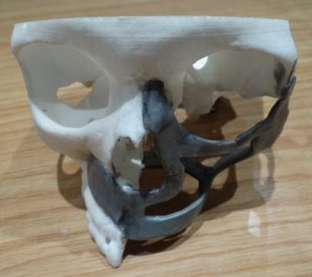
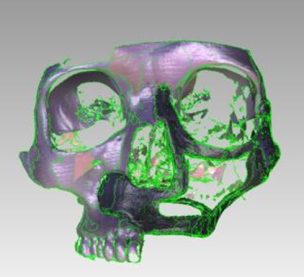
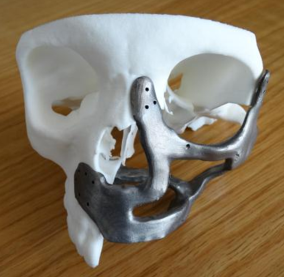
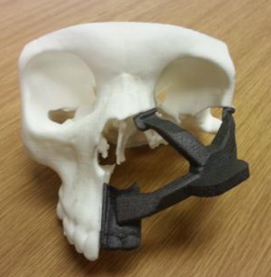
A female patient presented with a tumour affecting the hemi-maxilla and orbital floor of the left eye which had to be removed (a). Due to the extent and complexity of the defect, it was decided to fabricate an anatomical model of part of the scull in nylon through 3D printing to plan a framework for the patient to be manufactured in titanium (b). The CRPM had only two weeks to design and manufacture the titanium implant, due to the rapid spreading of the cancer. It was decided to send the nylon model to the prosthodontist to cut where the bone resection was planned and to produce a wax model of the planned titanium frame (c). The wax model and skull were reversed engineered using a Minolta 3D camera and Geomagic® software (d). The implant design was transferred to the CRPM’s EOSINT M280 DMLS machine and manufactured from titanium powder. The implant was manually polished and the fitment was checked on the pre-operative model (f). A cutting guide was designed and manufactured in nylon through 3D printing which the surgeons used to cut the affected bone at the correct angles (g). The titanium prosthesis was successfully implanted during a nine-hour operation. A skin flap was removed from the patient’s forearm and used to separate the oral and nasal cavities. The post-op review was good and the patient was transferred after a week from the Intensive Care Unit to a general ward. The operation was performed 14 days after the CT data was received which is significantly shorter than the five weeks that it would take to manufacture the prosthesis through conventional machining techniques.
News


