
The TTO was an office established by NIPMO at the CUT in 2009 following the enactment of the Intellectual Property Rights from Publicly Financed Research and Development (IPR) Act of 2008. This Act governs Intellectual Property that flows from publicly financed Research and Development (R&D).
Core Functions of the TTO
1. IP Management and Administration
Overseeing the protection and administration of intellectual property assets.
2. Technology Commercialisation
Facilitating licensing agreements and the creation of spin-out companies.
3. Advocacy and Awareness
Promoting technology transfer and IP awareness across the university community.
4. Contracts and Agreements
Managing legal contracts and agreements related to IP and technology transfer.
5. Researcher Support
Providing dedicated guidance and support to researchers throughout the innovation process.
Intellectual Property (IP) Overview
Intellectual Property (IP) describes the application of the mind to develop something new or original. It can exist in various forms, such as a new invention, brand, design, or artistic creation. In today's knowledge economy, IP is a critical asset that should be strategically managed.
Types of IP in South Africa
- Trademarks
- Patents
- Designs
- Copyright
Registered IP rights serve as an incentive to reward innovation by providing creators with the time and opportunity to exploit their creation. While some rights require formal registration, others (like literary works and music) exist automatically. The TTO assists researchers in identifying and registering IP emanating from their research.
How to Disclose Your IP
Step 1: Complete the IP Disclosure Form (DOCX).
Step 2: If there are multiple contributors, ensure all parties complete the IP Contributors Form (DOCX) to clarify ownership in accordance with the IPR Act.
Note: The creator of IP is not necessarily the owner. The TTO assists in clarifying ownership ambiguity.
Are you an undergraduate student with a great idea? Visit the i-GYM page to get started.
Measure the Technology Readiness Level (TRL)
Technology Readiness Levels (TRLs) are a method for estimating the maturity of technologies during the acquisition phase of a program, originally developed at NASA during the 1970s. The use of TRLs enables consistent, uniform discussions of technical maturity across different types of technology.
When it comes to inventions and innovation, it is important to identify at which level the current technology is before commercialisation can be considered. The TTO can assist in prior-art searches of related technologies to help innovators further or alter their course of action.
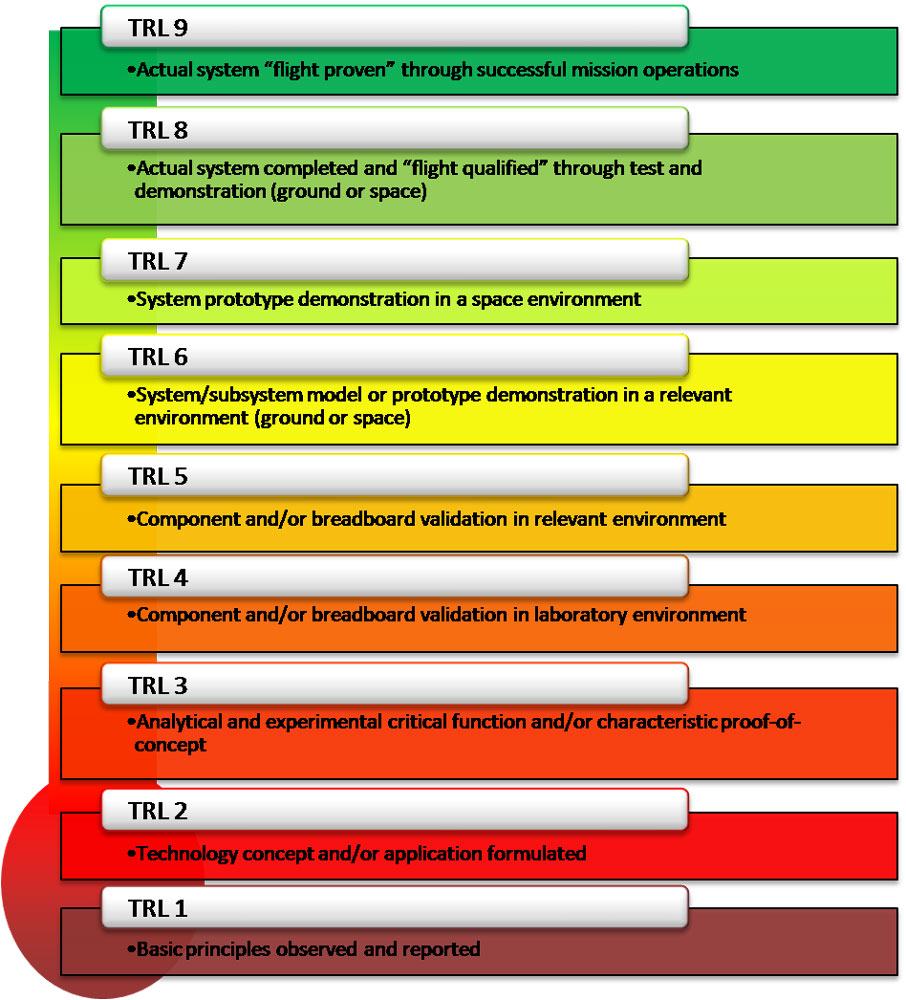
TRL Comparative Chart
Commercialisation
Commercialisation is the process of introducing a new product or production method into commerce—making it available on the market. The term often connotes entry into the mass market, but it also includes a move from the laboratory into commerce.
Commercialisation Mechanisms
The TTO assists with the commercialisation of IP and technology emanating from research within CUT through the following mechanisms:
Licensing
Granting rights to existing companies to use and commercialise the technology.
Spin-outs
Creating new start-up companies based on the university's IP and research.
Partnerships
Forming Joint Ventures or strategic partnerships in particular circumstances.


