
University-Community engagement a way to go
Universities are known to be knowledge hubs where academics must acquire and demonstrate the knowledge gained in order to be awarded degrees, but the 21stcentury scholars believe in combining formal university education with community knowledge to prosper.
The university’s Vision 2020 Statement places emphasis on social and technological innovations, socio-economic development with the aim of creating jobs (innovative and entrepreneurial spirit) and be engaged with its communities. The university is challenged to mainstream the curriculum in support of this mission statement.
As the only University of Technology in the Central Region, CUT is dedicated and passionate about integrating with social communities and has over the years built strong and sustainable relationships. The relations have since given birth to local business innovative empowerment, numerous collaborative research with knowledge holders, changing the lives of ordinary people using advanced medical technology (3D printing) and collaborating with local government in enhancing the knowledge and skills of local teachers.
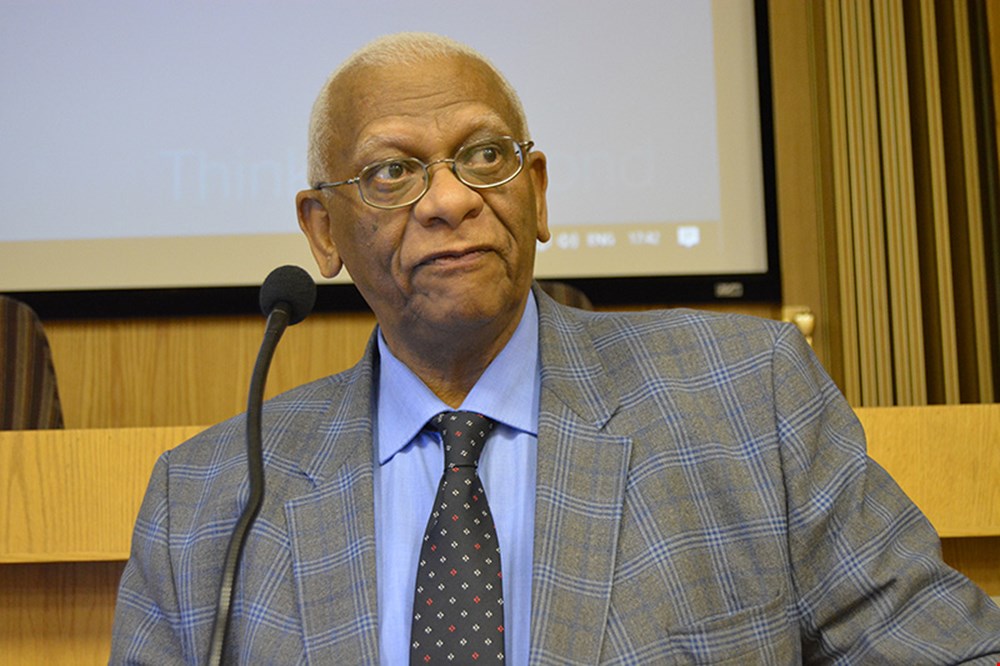
On 16 May 2018, the Research, Innovation and Engagement: Community Engagement unit hosted a public lecture delivered by Dr John Volmink titled ‘Pedagogy of University/Community Engagement: Reciprocity for Mutual Benefit’.
The purpose of this lecture was to reflect on the value of universities working in partnership with communities in advancing academic projects of the university by combining the university knowledge and community experience to address social disadvantages and exclusion.
When unpacking his arguments, Dr Volmink applauded CUT for its mission statement. “This speaks to me precisely and eloquently of a university that is dynamically engaged with its community. One would expect any graduate from this university to live out this mission in the world.”
He mentioned the UNESCO report of 1998 entitled ‘The treasure within’ points outthat education through life is based on the four pillars, namely:
Learning to know: he explained that it is not the accumulation of credits and certificates that should be the artefacts of our academic pursuits-that we call success, “success is what you do for yourself while significance is what you do for others.” Learning to do: He stated that as a community of practice that learns through doing, people should learn to acquire the competence to deal with complex situations of the real world rather than occupational skills. Learning to live with others: He emphasise that the university is a community where we celebrate diversity, and through transformation, we are learning to live together in a way that expresses our common unity and humanity, acceptance and embrace our differences, affirm, support and respect each other in a way that shows that we have learnt to live together in a vibrant and transformed community. “The world is not only a physical world but social world too.” Learning to be: Each one must learn to be everything that we were meant to be and resist any attempt to make us believe that the limitation is within us when in fact we fail to see the constraints and barriers on the outside. “No university can define excellence without reference to its pursuit of knowledge. There is institutional knowledge and knowledge in the community and both kinds should be valued and celebrated.”
In his view of success, he mentioned that institutional knowledge is necessary but not sufficient to engage the world. He spoke about Asset-Based Community Development (ABCD) where he mentioned that people who make a difference in the world are those who have a deep appreciation for the power of knowledge in their communities. “We need to recognise that marginalised and abandoned people in communities feel hurt and disrespected. So, as we engage with communities, an appropriate posture is to start with respect rather than with presumptive arrogance as to what knowledge becomes official. Are we creating opportunities for the voices to be heard before we decide what is best for them?” He asked.
Dr Volmink concluded the lecture on service learning and how universities and communities can learn from it. “I agree with the CHE report that successful sustained service learning requires strong institutional support, partnership and commitment from academics. Service learning is one of the most important ways for universities to connect with communities as it combines learning goals and community service in ways that can enhance both student growth and the common good.”
His advice to universities is to advance academic projects so that communities can benefit from their interaction with universities such as CUT. “Universities have a role to play in acting locally, while thinking globally. I believe that younger Universities of Technology (UoTs) have a stronger chance to break away from traditional models and make a difference in this country and in the world, “he concluded.
The Public Lecture by Dr Volmink was followed by a 2-day training workshop on 17-18 May 2018. Staff and students attended the workshop to have a better understanding of community engagement and get proper training on mainstreaming community engagement into the curriculum as well as transdisciplinary projects and research. Facilitators from Universities of Limpopo, Fort Hare and Cape Peninsula University also attended the workshop to share their views and experiences while also expanding their knowledge on community engagement topics.
Images
1: Dr John Volmink delivering the lecture on Pedagogy of University/Community Engagement: Reciprocity for Mutual Benefit.
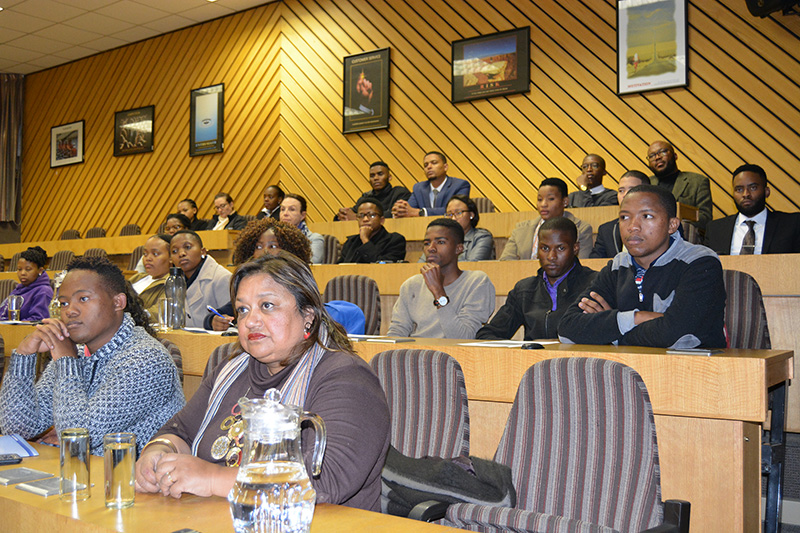
2: Staff and students who attended the event to get insight on community engagement.


