
News Articles
The Basotho Origin of Mathematics
Humanities
Mathematical and Physical Sciences
Teaching and Learning
CUT News
Research, Innovation and Engagement
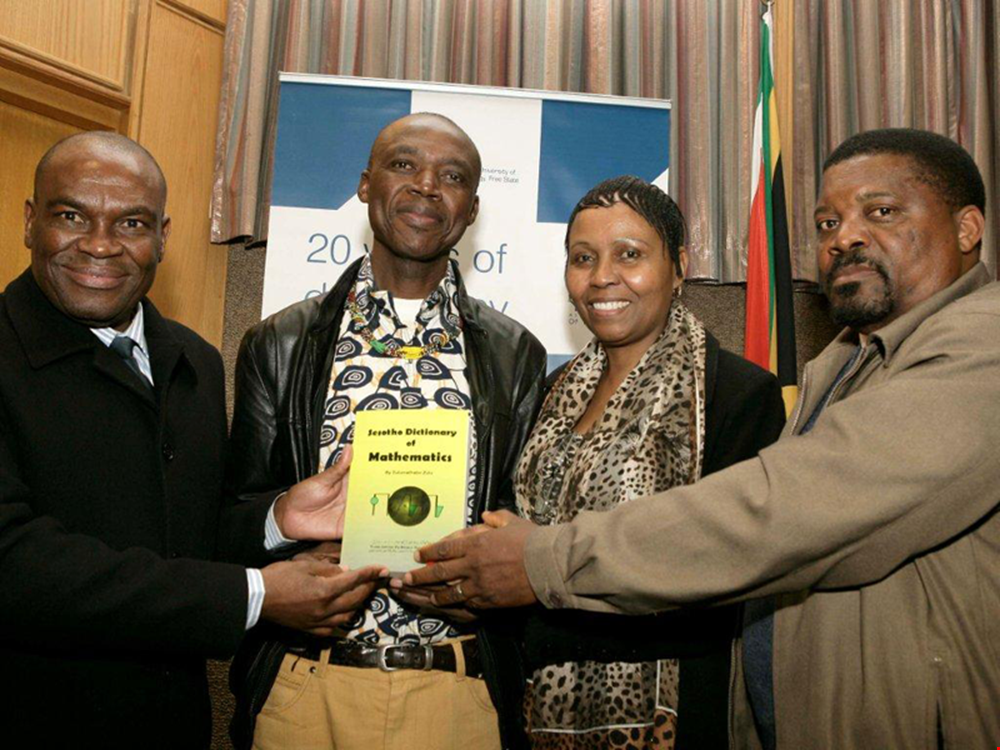
“The popular myth in South Africa is that the African natives were devoid of mathematical knowledge until the advent of Europeans. Nothing could be further from the truth!” These were the words of Mr Zulumathabo Zulu, a guest speaker in his opening remarks at the public lecture that was hosted by the Faculty of Humanities at CUT on 12 June 2014.
An author of the Sesotho Dictionary for Mathematics, Zulumathabo Zulu was born in Soweto, but grew up in the village of Matamong in Free State where he acquired his indigenous knowledge system in a traditional African society. He immigrated to Canada in 1989 where he graduated as a software engineer and plied his trade in companies like Montage IT Services, Xwave, Adscape Media of Google Inc. and Nortel Networks. In his presentation, Mr Zulu argued that Africans had known Mathematics long before the advent of colonisation. Important to his assertions was the cosmic knowledge of Basotho which was unique skills of mathematics that they used for looking into the stars to trace their genesis and gather intelligence and guidance they needed; especially for their harvesting period. He also mentioned that Moseme was used for ages among Basotho as a quadrate that served a variety of functions such as being a mat and a measuring tool for building structure. He told the audience that he was not surprised why Pythagoras was credited for introducing the concept of quadrature after spending years in Africa; he learnt this mathematical concept while studying in Egypt. “Basotho were able to count, estimate, measure, philosophise, solve, and model things.” He said that referring to the indigenous games that they used to play including Morabaraba and Diketo, which he said, had many powerful mathematical concepts. “As you play Morabaraba, you interact with the concepts and for one to know and understand the game; one has to have the mathematical prowess.”
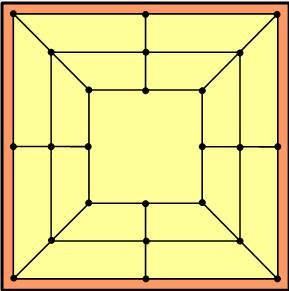
Morabaraba board game[/caption] Two players play the game. Each player needs 12 tokens izinkomo or cows. These could be stones, marbles of the same or similar colour and there will be one blank space to allow movement in the play. He also mentioned lewa as an algorithm that is used to set schemes and patterns. Other advanced mathematical concepts include binary logic, heuristics, permutations, and legutla, which is a direct translation of a recursive system. He also shared with audience one of the Ancient games: Diketo which required a player to have counting skills. He said that the game was and can be used to model natural phenomena such as counting, causation and flight. Mr Zulu is the inventor of Thekwini, software engineered for therapeutics at the School of Computer Science under the mentorship of Dr Jansen Sedgwick of Carleton University. His other innovations include cryptography, digital forensics, and mood diagnostics. “It is unfortunate that the official curriculum has marginalised traditional knowledge as if it had nothing to contribute to the advancement of modern science. Education should not be like a parachute that lands and never incorporate traditional knowledge. The curriculum must reflect a locally grounded knowledge while embracing a global perspective,” Zulumathabo concluded.
Image
Prof. David Ngidi, Dean of the Faculty of Humanities; Mr Zulumathabo Zulu, the guest speaker and author of Sesotho Dictionary of Mathematics; Dr Wendy Setlalentoa, Head of the Department Mathematics, Science and Technology Education; and Mr Lukanda Kalobo, Lecturer in the Faculty.
News


