
News Articles
Technology Integration in Teaching and Learning
Engineering, Built Environment and Information Technology
Teaching and Learning
CUT News
Widening Access and Facilitating Student Learning In the last few years, many important changes have occurred in the education systems, which require teachers to upgrade and refine their technological skills in the transaction of learning.
The focus has now shifted from a mastery of content to preparing students to become citizens for life. Some of these changes are due to the evolution of government policies related to the use of information technology (IT) in schools while others are due to unavoidable developments caused by the influence of technology in our daily lives. On 26 September 2014, Faculty of Engineering Information Technology at CUT held a workshop on “Integration of Technology in Teaching and Learning" where they invited the ‘gurus’ of the subject matter to share some knowledge and skills on how the faculty can do better in widening access and facilitating student learning successfully. The guest presenters shared their knowledge and expertise on Technology integration in a daily classroom practice.
Prof. Peter Dunsby, from the University of Cape Town (UCT), explored the feasibility of using iPad in teaching and research. He shared his knowledge on Latex, mobile library apps and electronic signature implementation. He further explored the usage of a white board and some electronic marking tools before ending up with a journey on creating iBooks. “Technology integration in teaching and learning has become an essential tool in meeting the need of students in an active engagement. It facilitates collaborative problem solving, visual engagement, instant feedback, flexibility, accessibility, as well as support in the curricular goals. It engages the students in a meaningful learning,” he said. Mr Denzil Chetty, a tenured academic at UNISA also shared his experience with Ubiquitous learning that is highly used at Shanghai University, China. Ubiquitous computing is a concept in software engineering and computer science where computing is made to appear everywhere and anywhere. Mr Denzil was awarded the Shanghai Open University African Visiting Fellowship early in the year, and got an opportunity to explore how the University advances their use of Ubiquitous technology to develop a learning society within a learning city. He also tapped into Quality Enhancement Project (QEP), a project that has been implemented in all universities of South Africa with the aim of improving student success in Higher Education Institutions (HEIs). One of the goals of QEP is to develop a higher education system that is continuously improving and able to collaborate, share good practices, and solve shared problems. Focus area 3 of the project, aims to enhance the learning environment (including teaching and learning spaces, ICT infrastructure and access, technology-enabled tools and resources, and library facilities). “Everyone is exposed to the technology world and starting it in the classroom will create a foundation for teaching skills and knowledge required to match their global counterparts. Technology is fun and interactive and assists in visualising, tracks progress, shares knowledge and the information is accurate and quick.
Teaching and learning is constantly evolving and technology seem to be the bigger player in the game as schools and universities learn new interesting and fun modes of teaching in the technology era, making teaching and learning fun with the equipment that are all time favourites to the now generation,” he concluded Dr Nina du Toit, from Cape Peninsula University of Technology (CPUT), took the audience through her 30 years of experience, working with learners with disabilities and the different disability modes and types used. She discussed different case studies of different disability types. Moreover, she discussed the available facilities by the disability units at CPUT including some innovative solutions for expensive IT systems.
Image
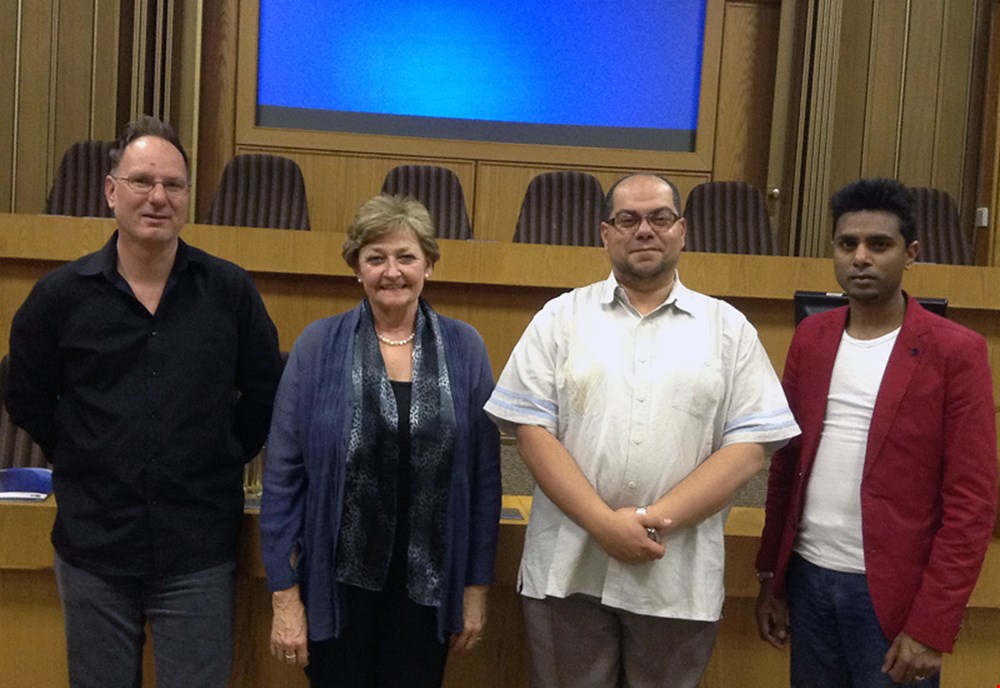
Picture above is the presenters; Prof. Peter Dunsby, Dr Nina du Toit, Dr Mohamed Mostafa, a Civil Engineering Senior Lecturer at CUT and Mr Denzil Chetty.
News


