
News Articles
Planning Games extended to local communities
Management Sciences
CUT News
Sustainable Development (SDGs)
Community Engagement
Teaching and Learning
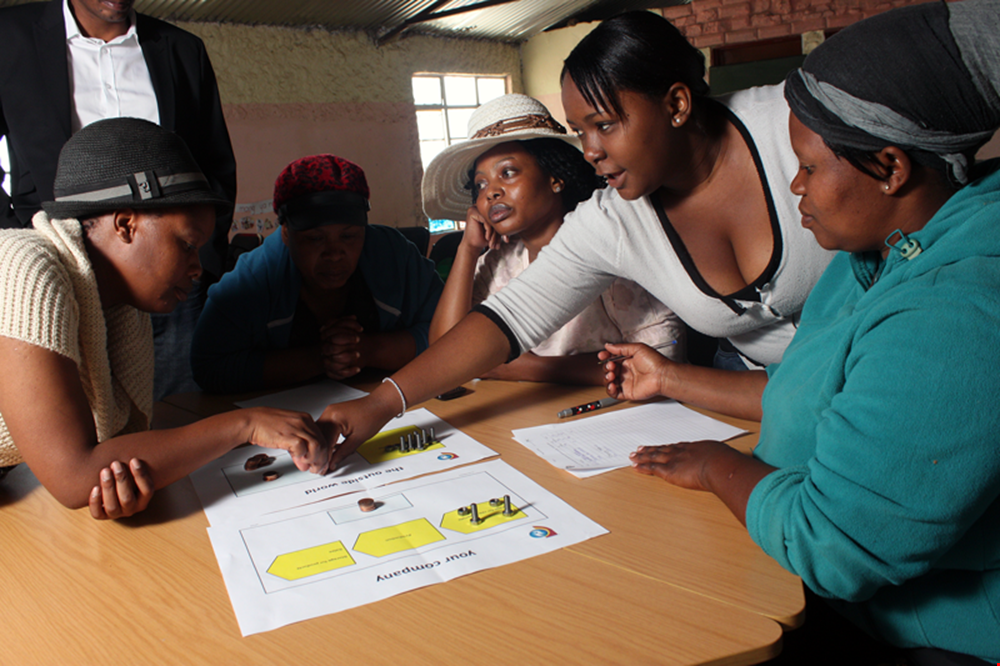
On 27 October, Faculty of Management Sciences took steps to strides in ensuring that CUT becomes the driver and leader in promoting entrepreneurship, a skill that is in high demand across the globe. Assisted by the Mentors and Enactus, Dr Edem Agbobli and his team, Mr Sapokie Ramorena and Mrs Rosaline Sebolao from the faculty, took it upon themselves to plough back to the community in a form of a skills enhancement workshop.
To achieve this, the faculty in conjunction with Aalen University (Germany) developed an educational game system, dubbed Planning Games, which will have several levels based on corresponding concepts of value and principles of economics. The development and deployment involves various stakeholders within the institution, industry, community, and education. The Hillside community became the ideal pilot as the majority of the community members are unemployed and semi-literate. The project champion and team member for Planning Game Development, Dr Edem Agbobli, highlighted that the project is a pilot and it is intended to teach prospective business people how to keep their records and transactions, how to penetrate the market and record their products, as well as how to keep a track record of their capital and profits. “The purpose of extending the concept to the local communities is to develop their business skills and equip them with the knowledge in economics and entrepreneurship and this will in turn increase and improve business survival and growth that will lead to job creation and socio-economic development of the region and the country.
Training schedules consists of levels that will grow and develop participants to skilled, competent, and independent business people. As they reach level 6, they will know all the principles in the business sector and all those skills will sustain and grow them further. Should the project be successful, it will have a ripple effect,” he said. Bahedile Ntoagae is a businesswoman for Finale Trading & Project Business in Hillside. Her business was on the verge of collapse when she first heard about this opportunity while volunteering at her child’s crèche in Rorisang day care. “I am happy about what CUT is doing for our community. I was about to give up all hope because I could not see where I was going or what I was doing until the game plan workshop started. This is my first session in the introductory stage but already, I am enlightened and can see where I went wrong in my business. I was not recording my earnings, not to mention how much I invested when I started. I was literally living from hand to mouth, something that was killing my efforts. CUT came at the right time; I am thankful for that! I can’t wait to learn more.”
The workshop is structured as follows:
Level 1: The goal of the planning game is to introduce the players to the fundamentals of economics. The basic board contains places for a materials storage (procurement), production, product storage (sales) and money (cash, accounting). The external environment includes the market for raw materials and the product market. In level 1, the trainees do some elementary bookkeeping. The complexity of the cost structure increases from material costs, to variable production costs and fixed costs. Level 2: A game for accounting will be based on level 1, and will use the concepts of haptic games to introduce the basic concepts of accounting, bookkeeping, and controlling but also address the various ways of sourcing money to start the business (bank loans, shareholders, fundraising). Level 3: In this level, the market is introduced. Pricing and the various influences on the price will be addressed using the mechanisms from level 1. Other marketing issues like product properties and added value, market research, promotion and communication, distribution and cooperation will be learnt throughout the game. Level 4: This level introduces participants to management skills. Level 5: Strategy and Sustainability level cover all-important aspects from technical and financial calculations to marketing and human resources. The games involve concepts of sustainable development and strategic planning. Level 6: Business plan stage will equip participants with the ability to independently run their own businesses. This level integrates the former levels and uses their results (e.g. on marketing, finance, skills and planning) to create a business plan. A business plan structure will be provided and upon completion of the level, players will be able to develop their own.
Images
The Hillside group of beneficiaries who played the Planning Game. Ms Bahedile Ntoagae (on left, black hat) interacting with one of the mentors. The Planning Game is a board game with the initial purpose being to introduce the fundamentals of economics.
News


