
News Articles
Medical Innovation in 3D Printing changed lives
Engineering, Built Environment and Information Technology
Research, Innovation and Engagement
CRPM
CUT News
Partnerships
Additive Manufacturing (3D printing technology) has the potential to change lives, and the Central University of Technology, Free State is driving that change for the betterment of ordinary people.
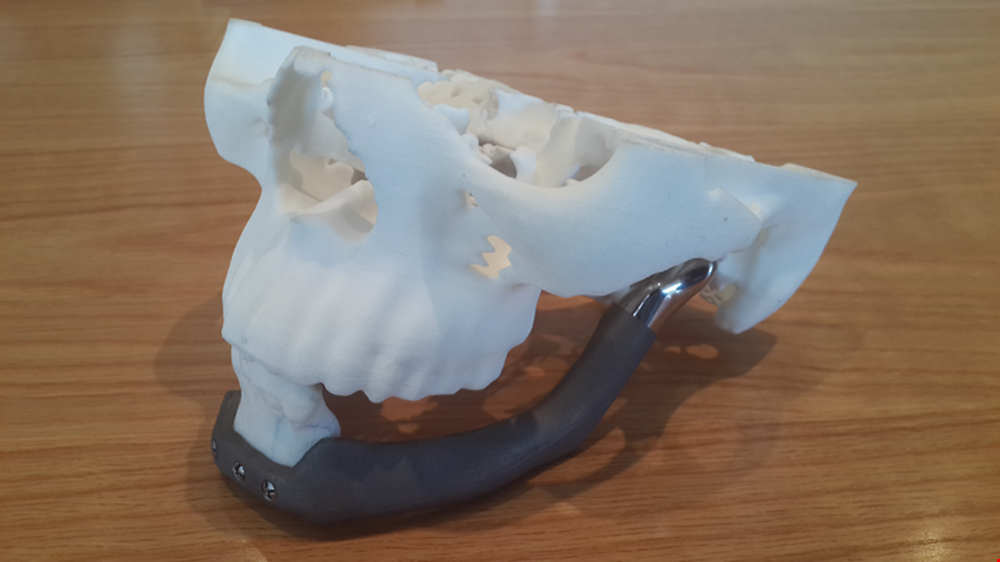
On 23 July, Dr Cules van den Heever, an Extraordinary Professor at CUT from the University of Pretoria, and CUT’s Centre for Rapid Prototyping and Manufacturing (CRPM) collaborated once again to change the lives of two patients whose mandible implants were moulded with the use of 3D printing at CUT’s Bloemfontein campus. During the procedure, Dr Walleed Ikram, Head of Kimberley Hospital Dental Unit, Dr Kobus Hoek, a maxillofacial surgeon, and doctors Philip Johnsson and Riaan Liebenberg, both dentists at the Hospital, played a role in assisting Dr Cules. “Dr van den Heever is a very well-respected and well-known expert. He has worked in this industry for many years and we are incredibly pleased to have him,” said Prof. Henk de Jager, Acting Vice-Chancellor and Principal of CUT.
This is groundbreaking work in 3D printing in the medical field. The two patients received titanium implants after losing significant portions of their jawline due to cancer and other related diseases, which left them with severe facial disfigurement. CRPM was established in 1997 as a centre for commercial work and research. CUT has been a national leader and a specialist in Additive Manufacturing (AM), and has made a huge and significant contributions to AM in South Africa. 3D printing was also used for pre-operational planning. CRPM and Product Development Technology Station (PDTS) partnership provides a one-stop solution for product and industrial designers to manufacture prototypes for form and function tests as well as final prototypes prior to tooling. “In driving development, our goal is to create a safe environment for medical practitioners to share their ideas, and form a consortium between them and CUT’s product development centre. This could have enormous potential benefit for both the medical profession and the AM environment”, said Mr Gerrie Booysen, Director of CRPM. The centre has an impressive array of state-of-the-art machinery and equipment, including the Objet Connex 350 3D printing machine that allows users to print using more than one material simultaneously. With the large investment and support from the National Research Foundation (NRF), the centre is able to provide both staff and students with exceptional tools to maintain their lead at the forefront of research into 3D printing technology. The centre also used this technology successfully in developing the first South African aircraft engine for Adept Airmotive, and is set to make a substantial difference in the competitiveness of these casting industries. The institution would like to thank the Department of Health in the Northern Cape for their assistance in the process and their facilities.
News of the patients: the operations went well and both patients are recovering in the Kimberley Hospital. CUT would also like to acknowledge Southern Implants, University of Stellenbosch (CAF)and the CSIR for their generous contributions towards making these operations a success.
Image
3D modelling of the patient and the implant, as well as the actual printed model and implant. The implant is fitted to the exact replica model of the patient before the operation allowing the doctors to see precisely what to expect when they operate. This pre-fit cuts down on the time the patient spends in the operating theatre (a costly endeavour), which in turn reduces the recovery time of the patient after the operation.
News


