
CUT strengthens strategic partnerships in the Northern Cape through Vice-Chancellor’s Business Breakfast

Prof. Samson Mashele, Deputy Vice-Chancellor: Research, Innovation and Engagement, presenting CUT’s strategic direction and highlighting opportunities for research, innovation and industry collaboration.
CUT hosted its second 2026 Vice-Chancellor’s Business Breakfast in Kathu, Northern Cape, reinforcing its commitment to strategic partnerships that advance skills development, accelerate innovation and unlock sustainable regional economic growth.
The Kathu engagement placed the spotlight on the mining industry, exploring how the university can contribute more meaningfully to the Northern Cape’s development priorities through skills development, applied research, innovation and closer industry collaboration. It builds on the momentum of last year’s Business Breakfast, with those conversations already translating into tangible partnerships and projects across the province.
Aligned with the university’s Vision 2030, the engagement showcased CUT’s focus on industry-relevant academic programmes, applied research and innovation, and partnerships that equip graduates to thrive in a rapidly changing world of work. Potential areas of collaboration presented to stakeholders included STEM scholarships, industry-sponsored projects, research and innovation programmes, entrepreneurship and Work-Integrated Learning, as well as partnerships in infrastructure development, digital transformation and renewable-energy solutions.
Vice-Chancellor and Principal, Professor Pamela Dube, who joined the engagement virtually, highlighted the growing impact of CUT’s partnerships in the region, pointing to an MOU signed with Khumani, a multi-million-rand project being implemented with Kudumane, and support from Sishen and SIOC, Kathu Solar Park, Rosond and the Northern Cape Provincial Government. “These partnerships demonstrate what is possible when we move from conversation to collaboration,” said Prof Dube, emphasising the importance of deepening existing relationships while creating new opportunities for industry, government and the university to work together on solutions that respond to the region’s development needs.
Deputy Vice-Chancellor: Research, Innovation and Engagement, Professor Samson Mashele, outlined CUT’s Vision 2030 ambition to be a future-focused university that translates knowledge, research and innovation into meaningful societal and economic impact.
He highlighted the university’s growing research and innovation performance, noting that CUT submitted 313.4495 research credit units for its 2025 outputs, representing a 6.93% increase from 2024. The Centre for Rapid Prototyping and Manufacturing (CRPM) further demonstrated the university’s capacity to deliver industry-focused solutions, completing 281 projects valued at approximately R3.2 million.
CUT’s contribution to the Northern Cape is also reflected in its graduate footprint. Between 2020 and 2026, the university recorded 1 076 graduates from the province, including 447 graduates from the Faculty of Engineering, Built Environment and Information Technology. “This growing pipeline of skilled graduates reinforces our role in developing the STEM capabilities needed to support the province’s mining, energy, technology and broader economic ambitions,” Mashele said.

Mr Shawn Modise, Chief Executive Officer of the Northern Cape Economic Development Agency (NCEDA), delivered the keynote address, highlighting the province’s emerging economic opportunities and the importance of stronger collaboration between industry, universities and TVET colleges.
Delivering the keynote address, Mr Shawn Modise, Chief Executive Officer of the Northern Cape Economic Development Agency (NCEDA) and a proud CUT alumnus, reflected on the province’s emerging opportunities and emphasised the need to strengthen connections between industry and institutions of higher learning.
He said the province’s development requires a deliberate and forward-looking approach to building the skills and capabilities needed to support emerging industries. “We need to create an ecosystem that is responsible and sustainable,” he said, linking the Northern Cape’s industrial ambitions to decarbonisation, renewable energy and the creation of new economic opportunities.
Modise identified green hydrogen as a significant opportunity in the province’s energy transition, alongside the vast potential of its renewable-energy resources. He called for deeper collaboration between industry, universities and TVET colleges to ensure that education and skills development keep pace with the demands of emerging industries. “We cannot do it alone,” he said, emphasising the need for collective action across the skills, education and economic-development ecosystem.
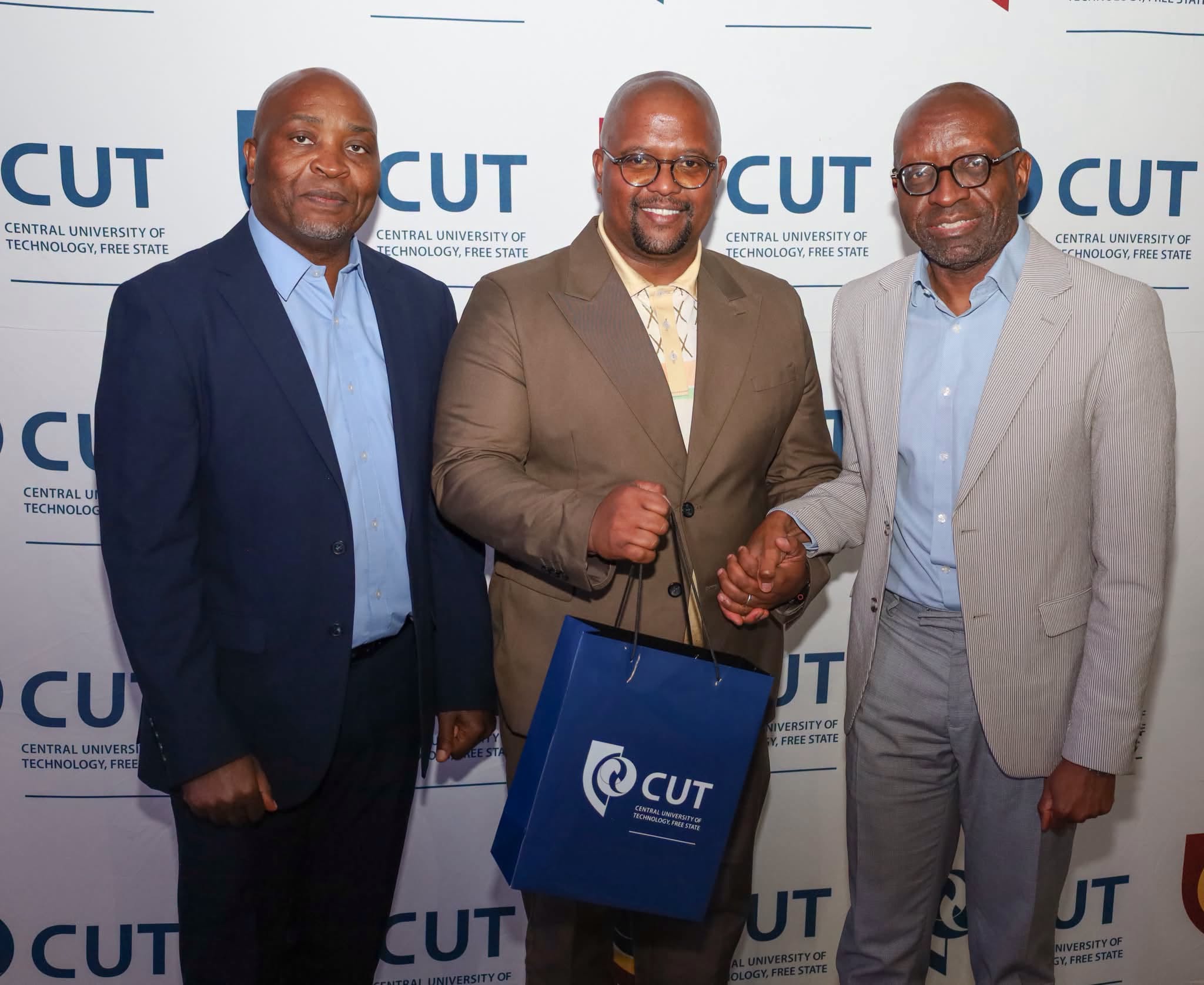
From left: Mr Qondakele Sompondo, Director: Institutional Advancement; Mr Shawn Modise, Chief Executive Officer of the Northern Cape Economic Development Agency (NCEDA); and Prof. Samson Mashele, Deputy Vice-Chancellor: Research, Innovation and Engagement.
He also identified the 3D dynamic as a potential area of collaboration and highlighted opportunities for CUT to contribute its technological expertise and research capabilities to industry priorities. “This aligns with CUT's focus on applied innovation, industry readiness and developing solutions that respond to real-world challenges, he added.
A strong sustainability theme also emerged from the engagement, with Modise highlighting the need to ensure that industrialisation is accompanied by responsible environmental practices, including reducing greenhouse-gas emissions, improving waste utilisation and exploring opportunities presented by renewable energy.
The Kathu Business Breakfast strengthened a simple but powerful message that the Northern Cape’s opportunities in renewable energy, green hydrogen, critical minerals and technology can only translate into lasting economic growth through meaningful partnerships. For CUT, that means working alongside industry and government to equip the next generation, turn research and innovation into practical solutions, and help build a more skilled, sustainable and future-ready province. More than an academic institution, CUT is positioning itself as a strategic partner that listens, collaborates and acts; turning shared ideas into opportunities that create real and lasting value for the Northern Cape.


