
News Articles
CUT Scientists collaborate with traditional healers
Health and Environmental Sciences
Clinical Sciences
Research, Innovation and Engagement
CUT News
Community Engagement
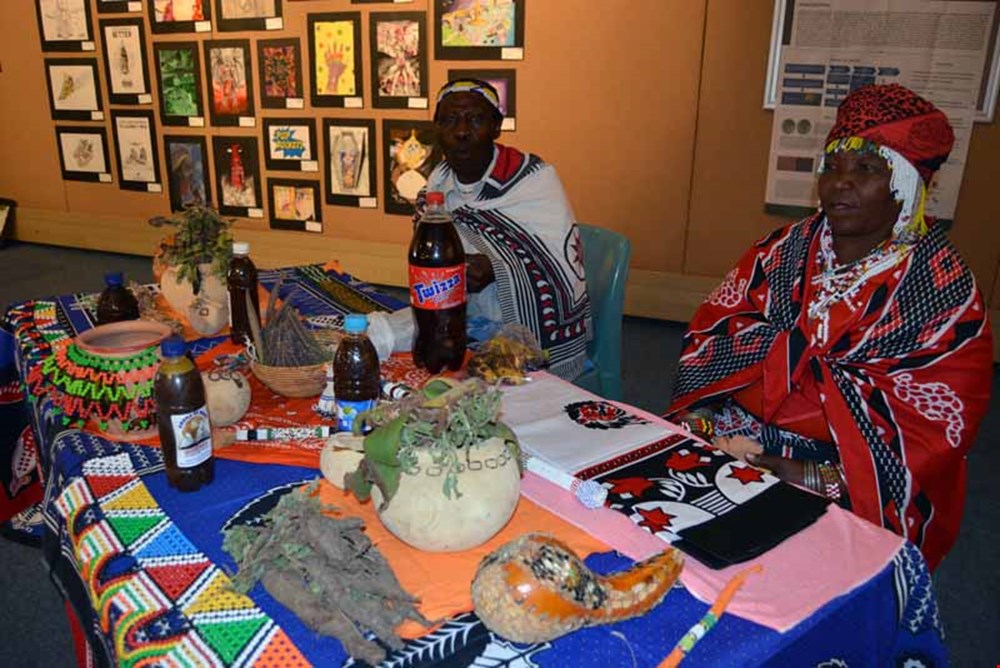
As part of heritage month celebration, the Faculty of Health and Environmental Sciences in collaboration with the Faculty of Humanities co-hosted an art exhibition on 20 and 22 September 2016 to exhibit creative and innovative works of students from graphic design, photography and fashion programmes.
The exhibition was also about collaborative projects between CUT and traditional healers and how to integrate indigenous knowledge reference to medicinal, food, and essential oils and the value that it carries. The Faculty of Health and Environmental Sciences exhibited traditional health care products which have indigenous properties to heal day-to-day ailments and chronic illnesses such as cancer and diabetes. The exhibition involved ethnobotanical surveys and the systematic documentation of indigenous knowledge, propagation, agro-processing, and beneficiation of key plant species, scientific validation of medicinal claims, evaluation of nutritional value, as well as evaluation of toxicity of raw materials and end products.
The envisaged products (pharmaceuticals, nutraceuticals, cosmeceuticals and teas and vegetables) will be aligned to the culture and needs of the local people. Both the faculty and traditional healers represent a model of collaboration which will not only be mutually beneficial, but also central to the aspirations of our vision in terms of its broader objectives of conceiving and developing social and scientific solutions for the region. These solutions are now tested for treatment of illnesses. “I’m confident that this event came at the right time where students are requesting academics to decolonise the curriculum and Africanise it. We cannot start decolonising the curriculum without knowing what African knowledge holders pose,” said Dr Ntsoaki Malebo, Microbiologist and Head of the Clinical Sciences Department. “Once we know, we will take the knowledge and incorporate it within our curriculum to ensure that African knowledge is preserved and our learners know more about it. In this way, traditional knowledge will be rescued and made relevant for contemporary life,” she said. According to Dr Ntsoaki Malebo, Indigenous Knowledge Systems Research in the Faculty started indirectly with Ethno Pharmacology Projects led by Professor Samuel Mashele who is the Dean of the Faculty.
During that time, a group of researchers partnered with the Kopanang Dingaka Association of Thaba Nchu an association of traditional healers who have so far, contributed immensely to the research carried out by scientists. The team has since started a project for the establishment of medicinal plants garden in Thaba Nchu. To date, more role players are involved and the research has become multidisciplinary. Research activities now involve plant propagation, agro-processing, and beneficiation of indigenous plants. The key role players in the project are Dr IT Manduna, Ethnobotanist, Dr Ntsoaki Malebo, Microbiologist, Mr Lesitsi Kobo, local farmer and Indigenous Knowledge holder, Mr T Ntjane and Ms S Mofammere, Traditional healers from Thaba Nchu, Ms M Malinga, Traditional healer from Reitz, Ms MV Sehlabo, Traditional Knowledge holder, CUTs Department of Agriculture, and Ms MJ Khamane, representative from the Free State Department of Health.
Image
From left: Mr Maele Ntjane and Ms Silvia Mofammere, traditional healers from Thaba Nchu displaying their medicine made from indigenous plants.
News


