
News Articles
CUT plays pivotal role in innovative medical surgery
Engineering, Built Environment and Information Technology
CRPM
CUT News
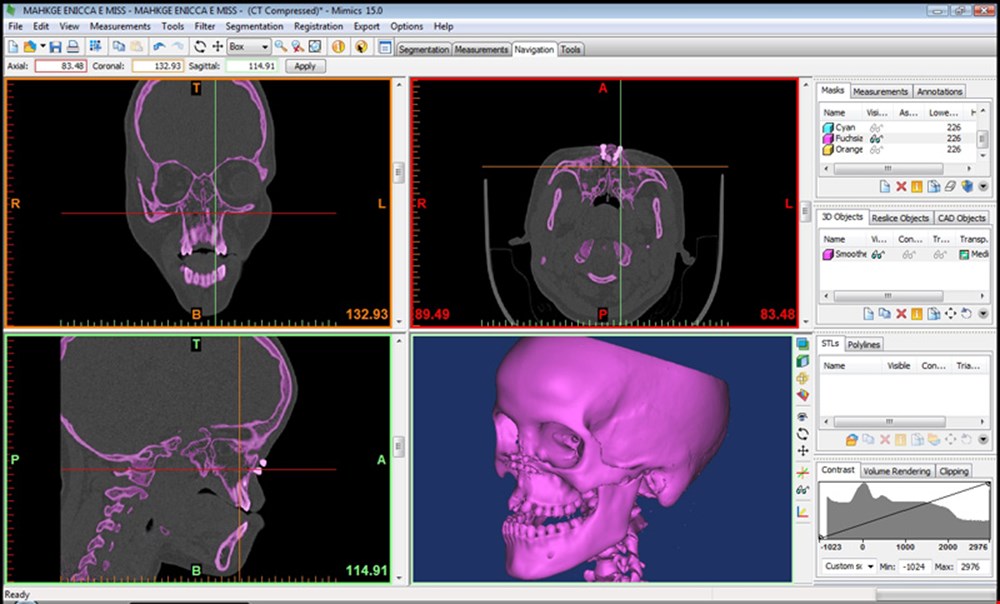
Innovation at CUT enabled a medical first in South Africa, when Ennica Mahkge, a young woman from Gauteng who was born without a nose and nasal passages received extensive jaw and facial surgery and a new nasal prosthesis at Mediclinic Kloof in Pretoria on Saturday, 22 June 2013.
To allow Mahkge (19) to breathe, an opening in her windpipe was created at birth, which unfortunately increased her tendency to develop upper respiratory tract infections, and ultimately caused a chronic infection. This resulted in the need to do a nose replacement operation, where nasal passages were created by moving Mahkge’s jaw forward and down, in order to create space for the new nasal passages.Central University of Technology, Free State (CUT), together with a team of specialists from the University of Pretoria and Mediclinic Kloof has been working tirelessly for months to make this life changing surgery possible. The Centre for Rapid Prototyping and Manufacturing (CRPM) at CUT played a vital role in the reconstructive surgery by using Additive Manufacturing technology, better known as three dimensional printing to construct two models of Mahkge’s skull so that the team of doctors could carry out pre-operative planning and simulate the operation. “These models were essential for the success of the operation, as the patient was born without a nasal passage. Without these models the operations would have been impossible”, said Dr van den Heever from the Department of Prosthodontics of the University of Pretoria (UP). “With only about 50 documented cases in the world and the first in South Africa, there is no absolute protocol in place for the surgeons to draw from,” says Gerrie Booysen, the Director of the Centre for Rapid Prototyping and Manufacturing (CRPM) at CUT.
“That is why the pre-operative models played such a vital role in empowering the doctors to plan and simulate the operation in the finest detail.” The pre-operative model assisted the surgeons to determine where the upper jaw needs to be cut in order to place it in the correct position and to prepare the titanium plates that was used to reconstruct the upper jaw. This shortened the operating time considerably, which reduces the chances of complications due to a prolonged operation such as infections or excessive blood loss.
News


