
News Articles
CUT hosted Rapid Product Development Open day
Engineering, Built Environment and Information Technology
Research, Innovation and Engagement
CRPM
CUT News
Partnerships
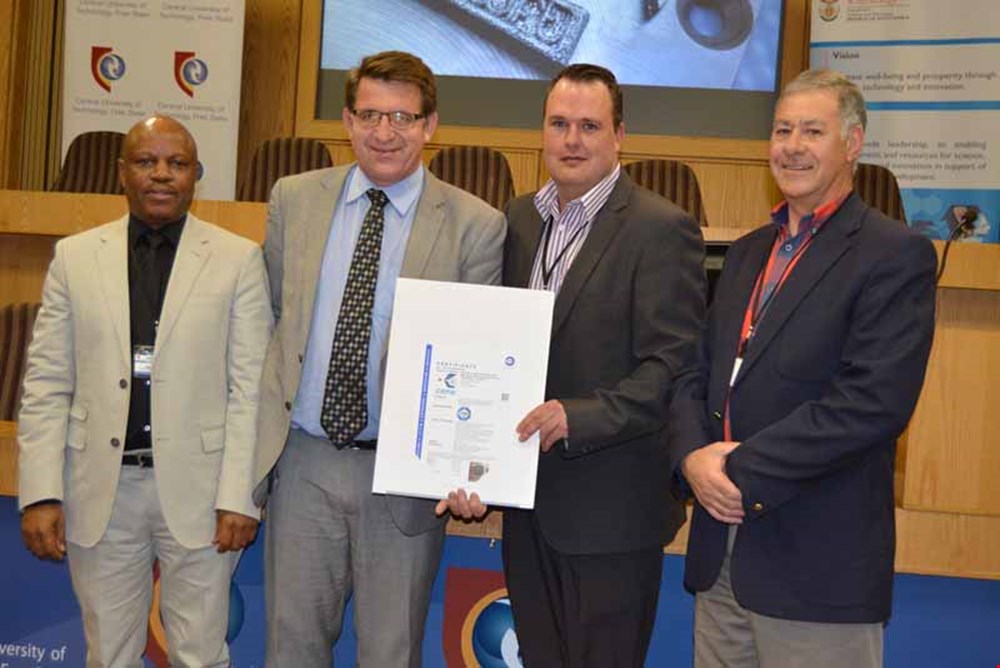
On 25 August 2016, CUT in collaboration with Rapid Product Development Association of South Africa (RAPDASA) hosted an Open day to launch the South African Additive Manufacturing Strategy since it was developed over the past two years with funding support from the Department of Science and Technology. Importantly, CUT also celebrated the certification of ISO 13485 which is accreditation for manufacturing of titanium implants using additive manufacturing. CUT is the first university in Africa and one of few in the world to receive this international certification.
The ISO 13485 certification is for 3D printing and medical devices and it means that CPRM has been certified worldwide. It brings good news for the university as well as South Africa meaning it will open doors for commercial manufacturing of medical devices here in South Africa. At the moment the university focuses on designing custom-made medical devices according to the needs or problem of individuals, This means that the university will no longer rely on Europe or America to acquire certification of its medical devices. From now on the University has the capacity to manufacture and sell certified medical products to doctors and hospitals. In his welcome address Prof. Alfred Ngowi, Dean: Faculty of Engineering and Information Technology said CUT Additive Manufacturing (AM) has taken place for many years through Centre for Rapid Prototype and Manufacturing (CRPM) which has been a national leader in this field ever since its establishment in 1987. Through the work of Prof. Deon de Beer, a founding member of RAPDASA in 2000, CUT’s research team was able to introduce Additive Manufacturing of titanium to South Africa's market and applied it to medical implants.
Today, the CPRM team is leading one of the programmes of the South African Additive Manufacturing Strategy that is qualification of AM of titanium 6 and 4 for medical implants and aerospace parts. Mr Hardus Greyling, Project Manager: AM Strategy Development from Council for Scientific and Industrial Research (CSIR) said that the South African Additive Manufacturing Strategy is focused on the development of niche areas to take advantage of high-priority opportunities that could contribute towards South Africa’s socio-economic imperatives. He said various opportunity areas for South Africa in the field of AM manufacturing were identified through three national workshops. The high priority opportunities for South Africa in the field of AM were identified as follows: Production of medical devices and implants; Production of parts for the aerospace industry; Refurbishment of parts and tools for the automotive and other industries; Impact on the local footwear industry through AM tooling and prototyping; Raw material development for AM processes; Development of high-end AM systems; and Development of low-cost 3D printer. He also mentioned institutions with the best infrastructure to support and develop AM further and CUT is one of the universities.
Images
1: From left: Prof. Alfred Ngowi, Dean: Faculty of Engineering, and Information Technology; Prof. Henk de Jager, Deputy Vice-Chancellor: Research, Innovation and Engagement; Mr Gerrie Booysen, Director: CRPM and Mr Andre ten Napel, Managing Director: TNMC Medical Devices SA.
News


