
News Articles
CUT explores Internationalisation for enhancement
Global Engagement
CUT News
Internationalisation has become a chant in higher education institutions. Universities across the world are encouraged to incorporate various methods of internationalisation within their scope to reap the benefits of global interconnectedness.
Each year the Central University of Technology, Free State (CUT) welcomes a range of international visitors from diverse backgrounds and cultures;
providing a home to a countless number of African and other international scholars. On 15-16 August 2017, CUT hosted a two-day seminar to enhance Internationalisation within the institution and provide a better understanding of internationalisation and its different components. The seminar provided an overview of comprehensive Internationalisation as an enabler for the institutions core business and also looked at the impact of Erasmus+ Projects on internationalisation including Strategic university partnerships as an enabler for internationalisation.
The concept of Internationalisation of the curriculum was also discussed as well as student mobility management, which includes financing, implementation, internal control systems and processes. Experts from critical accreditation bodies such as the South African Qualifications Authority (SAQA), Universities South Africa (USAf) and TVET colleagues presented various legislations and institutional policies governing the admission of the international student. Presenters from the University of Johannesburg (UJ) and Vaal University of Technology (VUT) also discussed ways to advance and improve services to international students while the International Student Administration Process at CUT was unpacked. International student recruitment challenges and opportunities were also extensively discussed to develop an international student recruitment strategy that will allow capacity development within the international student at CUT.
The importance of International Student Associations (ISA) was discussed as an enabler of internationalisation drive for student mobility at home and abroad. The association was established two years ago to enhance internationalisation and ensure that international students’ voices are heard. In his address Prof. Henk de Jager, Vice-Chancellor and Principal said the workshop was a good initiative, which would help CUT to revise and augment the current internationalisation strategy. He said it was critical to embrace the internationalisation project for competitiveness and ranking because it is a powerful tool in marketing the institution. “We need to align ourselves with all the tools and instruments of the various ranking system,” he said. He said that CUT is committed to promoting diversity for the purpose of learning different cultures, backgrounds and understanding different people.
“This year we have embraced a theme of the Human Project to give staff a meaning and make them feel they can make a difference and reach their full potential irrespective of their cultures and who they are or where they come from. We want to produce graduates and academic staff who are confident and sensitive when working in any cultural settings, understand different perspectives beyond that of their own and have a solid international experience. We want them to gain intercultural competencies to be flexible, curious, tolerant, adaptable, and able to communicate appropriately and effectively in multicultural teams and environments.”
Images
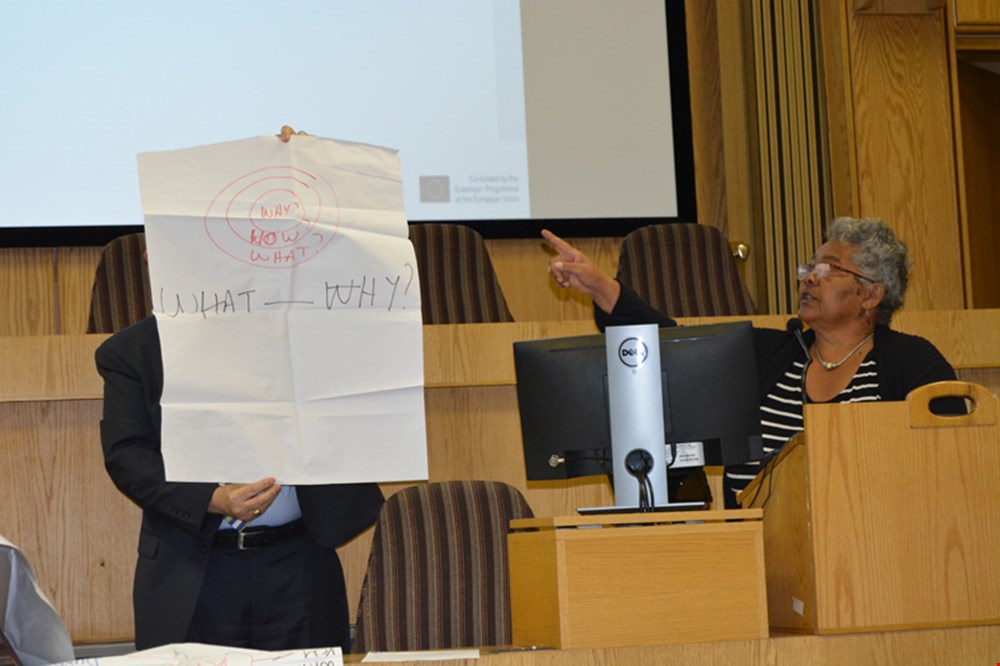
Ms Merle Mc Ombring-Hodges, external expert for an EU Erasmus+ Project, IMPALA presenting on the impact of Erasmus+ Projects on internationalisation.
News


