
CUT employees from humble beginnings towards greatness
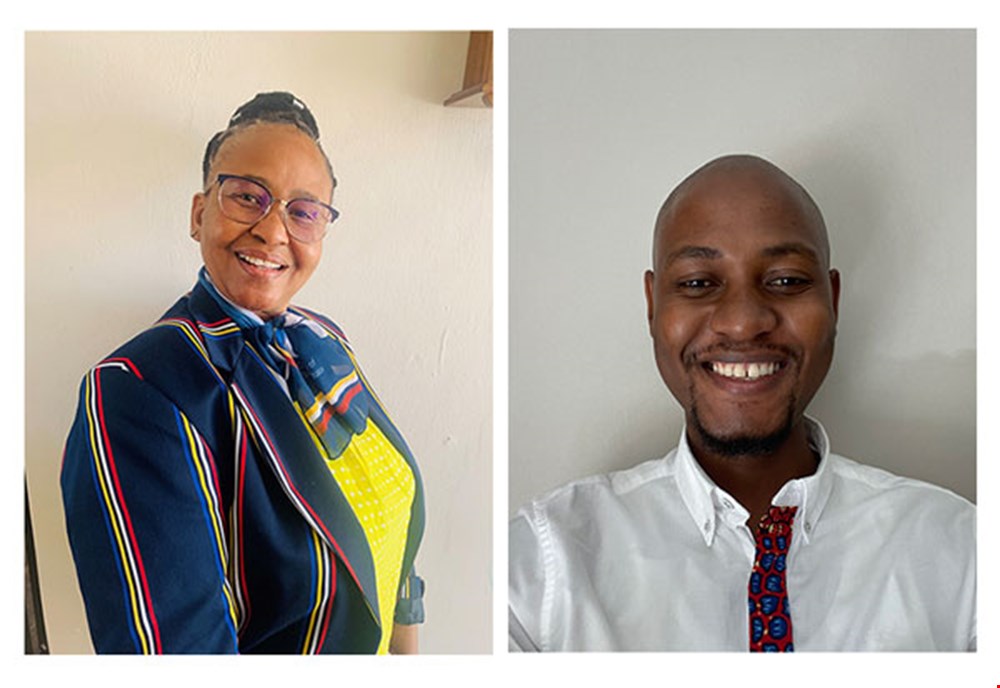
This week we get an insight into Drs Bridget Mangwegape and Zenzile Khetsha’s journey to success.
Dr Bridget Mangwegape has been involved in various research projects and has published five articles in accredited DHET conference proceedings. She is a mentee under the Scholarship of Teaching and Learning (SoTL) project and is currently involved in a research project on classroom practice. She is also supervising two master’s in education students, co-supervises three master’s in education students and one PhD: Languages’ student.
When she joined the Central University of Technology in 2015, Dr Mangwegape just had a master’s degree in African Languages and five years later, she successfully acquired her PhD. “My time here at CUT has been nothing short of an incredible experience. My journey has exposed my capabilities and potential. This also signifies the extent to which learning can do daily; one has to be willing and manage their time accordingly as learning and teaching has to take place simultaneously.”
Her area of research is Setswana Language. She realised in her research journey that there are gaps in some of the aspects in Setswana that needed to be bridged. As a Motswana woman from Kimberley, she has always had great interest in understanding the language she speaks more. “When I realised that I could further my academic career in Setswana, I didn’t think twice about it. I obtained my postgraduate degree and went straight into teaching Setswana at Kagisho Secondary.”
Education has always been her passion. Starting off her career as a secondary school teacher was where her dream to advance to bigger institutions began. “What I like most about my current position is that it involves some research activities in a higher education establishment, including presenting research findings at conferences nationally and internationally after that publishing articles in accredited journals and conference proceedings. CUT has been such a great encounter. It has opened doors for me and taught me so much about myself, personally and professionally. My family now has a direct influence on great academic success, and they continuously mention the inspiration that I am to them and those around them too.”
Dr Mangwegape sees herself as an Associate Professor and believes that with the support that CUT grants its employees to grow and develop, she will make it. “CUT is an institution that empowers its employees and grants them the opportunity to grow and develop. There are a number of learning and travelling opportunities to present research papers nationally and internationally that this institution offers, these opportunities mould multiculturalism and offer personal and academic developments.”
One of the major challenges that she has experienced was with her students, as most of them do not come to CUT with Setswana as their home language. “I would have to cement elementary knowledge as their lecturer to ensure that we are all on par but either than that, I have been fortunate enough to not experience anything strenuous whilst on my journey of achieving my career goals.”
Her advice to aspiring Setswana lecturers is to be willing to go an extra mile, acquire more knowledge, be open-minded, have an inquisitive mind and most importantly, be patient.
As a sub-committee member of the Setswana National Language Body (SETNLB) - Pan South African Languages Board (PanSALB) and the Spelling, Orthography and Terminology of Setswana National Language, the purpose is to empower the Setswana teachers and lectures about the latest research in the development of the Setswana Language. “The participants are workshopped on the current book of standardised spelling, orthography, and terminology of Setswana as a language. This initiative was taken to eliminate the non-agreement of Setswana language users in different provinces where it is spoken in respect of spelling, orthography, and terminology. The book was distributed to the participants. The usage thereof is to standardise Setswana in all sectors. Having said that, in the next five years, Setswana-speaking people in different provinces will be speaking Setswana with one voice.”
Dr Zenzile Khetsha started his career in 2009 as a Supplemental Instruction (SI) Leader and third-year student in the Department of Agriculture. This was followed by an appointment as a Lecturer Assistant in 2010, mainly to assist with the greenhouse maintenance. During this period, he enrolled for (then) BTech: Agricultural Management, which he graduated Cum laude.
By the end of 2012, he was promoted to a Junior Lecturer position, which upon graduating his Magister Degree: Agriculture, was employed as a permanent lecturer in the same department. He further enrolled for a doctoral programme in Agriculture under the supervision of Prof Sedibe and completed in 2020.
“To enhance my pedagogy in Higher Education (HE), I enrolled for a Postgraduate Diploma in HE, specialising in Agricultural Education. In 2021, I had met all the necessary requirements for a promotion into a Senior Lecturer position. Notably, from November 2021, I was then appointed as an Acting Assistant Dean: Teaching and Learning in the Faculty of Health and Environmental Sciences.”
His area of research is primarily Agriculture, specialising in Plant Production and Agricultural Planning Techniques. His research specialisation was inspired by his passion for plant agriculture and mentorship from Prof Sedibe which started in 2009.
Dr Khetsha said that he loves the academic world for the thrill it gives him, and he gets to learn a lot from the subject and his students. “I enjoy being in class, sharing knowledge, facilitating learning, and stimulating students in their field of study. What excites me most about my position is my engagement with students and creating a conducive atmosphere for learning, and of course; participating in research, and the chances of getting global exposure.”
His advice to wannabe lecturers is to first have the passion and interest in Teaching and Learning (T&L), not only facilitating learning but the philosophy that comes with HE challenges and contexts. Understand that knowledge sharing comes with a contribution to the body of knowledge; “you need the certificate to teach in HE and a PhD in your technical expertise.”
Khetsha also mentioned that he enjoys working for CUT and considers it as his second home. “CUT is my alma mater, and I would choose it any day. There is a lot of progressive opportunities and growth is inevitable here. The promotion policy is fair and open to all academics, one just needs to know where to go.”
“Academia is a community with its own cold rules that hardens the skins of many. I noted that throughout the different NQF levels, I slowly but surely developed a thick skin following challenges, which directly changed my perspective about life, “he said.
Dr Khetsha lives by this motto “the most powerful is he who has himself in his own power!”.
Caption
From left Dr Bridget Mangwegape and Dr Zenzile Khetsha.


