BEGIN:VCALENDAR
PRODID:-//github.com/rianjs/ical.net//NONSGML ical.net 4.0//EN
VERSION:2.0
BEGIN:VEVENT
DESCRIPTION:The Central University of Technology\, Free State (CUT)\, Sout
h Africa\, invites scholars\, academic developers\, postgraduate research
ers\, and higher education leaders to submit contributions to the 12th In
ternational Conference on the Scholarship of Teaching and Learning (SoTL)
. The conference theme\, Advancing Student Success through SoTL and Curri
culum as Praxis\, positions SoTL as a rigorous\, evidence-informed vehicl
e for enhancing learning through curriculum renewal\, purposeful pedagogy
\, and context-responsive educational innovation. SoTL&rsquo\;s distincti
ve contribution lies in making teaching and learning public\, transparent
\, and improvable through theoretically grounded inquiry that is both dis
ciplinary and interdisciplinary. A coherent conceptualisation of SoTL is
therefore essential to strengthen the quality\, communicability\, and imp
act of scholarly teaching investigations across diverse fields (Miller-Yo
ung &\; Yeo\, 2015). Within this frame\, curriculum as praxis emphasis
es curriculum as lived\, enacted\, and continually reworked through refle
ctive action that links what is valued\, what is taught\, how learning is
supported\, and how success is interpreted in real institutional context
s.Download the Call for PapersDownload the Call for Full Papers (PDF) | 0
4 August 2026Download the Call for Papers - special issue (PDF) | 27 May
2026AbstractDownload the Call for Abstracts (PDF) | 13 August 2026Student
success is not produced by curriculum structure or teaching technique al
one but emerges through an educational interface in which institutional c
onditions\, learning design\, relationships\, student identities\, and ac
ademic emotions interact to shape engagement and achievement (Kahu &\;
Nelson\, 2018). This conference foregrounds the value of SoTL as a rigor
ous way of making these interacting mechanisms visible and improvable\, p
articularly when curriculum is approached as praxis rather than as a stat
ic plan. Framing curriculum as praxis strengthens the link between theory
\, evidence\, and reflective action\, enabling institutions to design lea
rning pathways that cultivate belonging\, academic momentum\, and meaning
ful learning. In this sense\, the conference advances a SoTL agenda that
moves beyond generic claims about &ldquo\;what works&rdquo\; to develop t
ransferable principles\, context-sensitive evidence\, and actionable impl
ications for module\, programme\, and institutional improvement.Assessmen
t for learning and feedback are positioned as central levers in this prax
is-oriented approach because they powerfully shape what counts as knowled
ge\, how standards are interpreted\, and how students regulate their lear
ning over time. Throughout the learning process\, students are formativel
y assessed to give them and their lecturers information that promotes bet
ter learning and student growth. The importance of this focus is amplifie
d by the recognition that feedback only becomes educationally valuable wh
en students can interpret\, evaluate\, and use it to improve future work.
Strengthening student feedback literacy is therefore integral to advanci
ng student success\, as it supports learners&rsquo\; capacity to engage p
roductively with evaluative information and to develop agency and judgeme
nt in their learning (Carless &\; Boud\, 2018). By elevating assessmen
t and feedback as curriculum\, the conference highlights how SoTL can rec
onfigure assessment practices to support progression\, deepen learning\,
and build sustainable learning capabilities.The conference also treats AI
-enabled teaching and learning as a pedagogical and curricular question t
hat requires scholarly scrutiny rather than instrumental adoption. While
AI tools are rapidly entering educational spaces\, systematic evidence su
ggests that research in this area has often been technology-driven\, unde
rlining the need to reconnect AI applications to educator perspectives\,
robust pedagogy\, and ethical considerations (Zawacki-Richter et al.\, 20
19). A SoTL lens is essential here because it anchors AI adoption in evid
ence\, values\, and educational purpose\, and it supports principled appr
oaches to curriculum design\, learning activities\, assessment practices\
, feedback processes\, academic integrity\, and student support. In doing
so\, the conference frames AI not as a substitute for teaching expertise
\, but as a site for scholarly inquiry into how learning can be enhanced
in equitable\, transparent\, and human-centred ways.Conclusively\, the th
eme &lsquo\;Advancing Student Success through SoTL and Curriculum as Prax
is&rsquo\; explicitly connects student success to decolonising and divers
ifying learning\, recognising that epistemic access and belonging depend
on whose knowledge is legitimised\, whose languages are valued\, and whic
h identities are recognised in curriculum and pedagogy. Decolonising the
university requires confronting the politics of knowledge and the institu
tional conditions that shape what can be taught and learned (Mbembe\, 201
6). From a complementary perspective\, SoTL framed through social justice
insists that scholarly teaching must attend to equity\, recognition\, an
d participation\, not only to effectiveness in the abstract (Leibowitz &a
mp\; Bozalek\, 2016). Through bringing these concerns into conversation w
ith curriculum as praxis\, the conference positions SoTL as a vehicle for
transforming learning environments so that student success is advanced t
hrough inclusive\, context-responsive\, and socially just curriculum and
pedagogy.Submissions are invited under the following sub-themes:SoTL and
Curriculum Renewal: Exploring how scholarly inquiry informs curriculum tr
ansformation\, coherence\, alignment\, and responsiveness to diverse stud
ent needs.High Impact Pedagogy: Investigating evidence-informed teaching
strategies that promote deep learning\, engagement\, belonging\, and acad
emic momentum.Assessment for Learning: Reframing assessment and feedback
as curriculum practices that develop feedback literacy\, agency\, and sus
tainable learning capabilities.Student Success Pathways: Examining instit
utional\, programmatic\, and classroom-level interventions that strengthe
n retention\, progression\, and epistemic access.AI Enabled Teaching and
Learning: Critically exploring AI integration through a SoTL lens\, inclu
ding pedagogy\, assessment\, AI ethics\, governance and policy.Decolonise
and Diversify Learning: Interrogating curriculum\, pedagogy\, and assess
ment practices to advance epistemic justice\, inclusion\, and socially ju
st student success.We welcome research papers\, reflective practice paper
s and posters that clearly articulate a teaching and learning problem\, s
ituate it within relevant theory\, present appropriate evidence\, and off
er implications for curriculum and pedagogy that advance student success
in diverse higher education contexts. Please contact the SoTL office if y
ou would like to conduct a workshop during the conference. \;Submissi
ons \;DeadlinesDatesCall for Abstracts15 March 2026Closing date for A
bstract09 May 2026Notification for Accepted Abstracts17 &ndash\; 20 June
2026Registration closing date15 August 2026Conference Dates7 - 9 October
2026Full Papers for Special Issue20 October 2026Conference Registration F
eeCategoryPhysical AttendanceOnline AttendanceAcademic Staff / Profession
alsR3750R1500Postgraduate Students (Full-time or Part-time)R1500R1500Trav
el: where to stay\, sightseeingCommunication LogisticsFor any inquiries\,
please contact Ms Dineo Mopeli \;sotlconference@cut.ac.za \;
DTEND:20261009T160000
DTSTAMP:20261025T235231Z
DTSTART:20261007T090000
SEQUENCE:0
SUMMARY:12th International Conference on Scholarship of Teaching and Learn
ing (SoTL)
UID:f3fe0ab2-68ea-44f6-bbdb-ac4c2c6a5cc2
X-ALT-DESC;FMTTYPE=text/html:The Central University of Technology\, Fre
e State (CUT)\, South Africa\, invites scholars\, academic developers\, p
ostgraduate researchers\, and higher education leaders to submit contribu
tions to the 12th International Conference on the Scholarship of Teaching
and Learning (SoTL). The conference theme\, Advancing Student Success th
rough SoTL and Curriculum as Praxis\, positions SoTL as a rigorous\, evid
ence-informed vehicle for enhancing learning through curriculum renewal\,
purposeful pedagogy\, and context-responsive educational innovation. SoT
L&rsquo\;s distinctive contribution lies in making teaching and learning
public\, transparent\, and improvable through theoretically grounded inqu
iry that is both disciplinary and interdisciplinary. A coherent conceptua
lisation of SoTL is therefore essential to strengthen the quality\, commu
nicability\, and impact of scholarly teaching investigations across diver
se fields (Miller-Young &\; Yeo\, 2015). Within this frame\, curriculu
m as praxis emphasises curriculum as lived\, enacted\, and continually re
worked through reflective action that links what is valued\, what is taug
ht\, how learning is supported\, and how success is interpreted in real i
nstitutional contexts.
Download the Call for Papers
Downloa
d the Call for Full Papers (PDF) | 04 Au
gust 2026
Download the Call for Papers
- special issue (PDF) | 27 May 2026
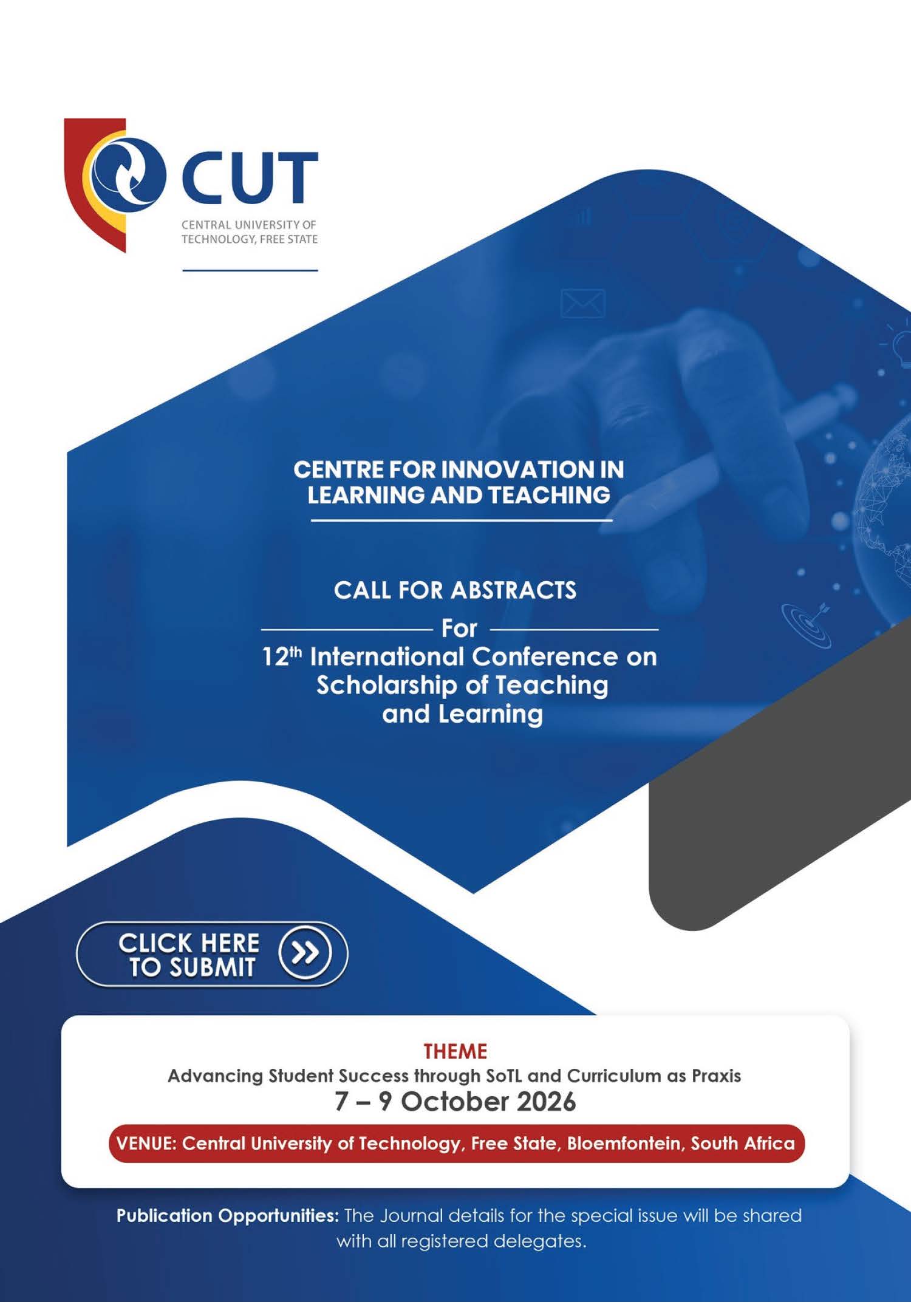
Abstract
Download the Call
for Abstracts (PDF) | 13 August 2026
Student success is not pro
duced by curriculum structure or teaching technique alone but emerges thr
ough an educational interface in which institutional conditions\, learnin
g design\, relationships\, student identities\, and academic emotions int
eract to shape engagement and achievement (Kahu &\; Nelson\, 2018). Th
is conference foregrounds the value of SoTL as a rigorous way of making t
hese interacting mechanisms visible and improvable\, particularly when cu
rriculum is approached as praxis rather than as a static plan. Framing cu
rriculum as praxis strengthens the link between theory\, evidence\, and r
eflective action\, enabling institutions to design learning pathways that
cultivate belonging\, academic momentum\, and meaningful learning. In th
is sense\, the conference advances a SoTL agenda that moves beyond generi
c claims about &ldquo\;what works&rdquo\; to develop transferable princip
les\, context-sensitive evidence\, and actionable implications for module
\, programme\, and institutional improvement.
Assessment for learni
ng and feedback are positioned as central levers in this praxis-oriented
approach because they powerfully shape what counts as knowledge\, how sta
ndards are interpreted\, and how students regulate their learning over ti
me. Throughout the learning process\, students are formatively assessed t
o give them and their lecturers information that promotes better learning
and student growth. The importance of this focus is amplified by the rec
ognition that feedback only becomes educationally valuable when students
can interpret\, evaluate\, and use it to improve future work. Strengtheni
ng student feedback literacy is therefore integral to advancing student s
uccess\, as it supports learners&rsquo\; capacity to engage productively
with evaluative information and to develop agency and judgement in their
learning (Carless &\; Boud\, 2018). By elevating assessment and feedba
ck as curriculum\, the conference highlights how SoTL can reconfigure ass
essment practices to support progression\, deepen learning\, and build su
stainable learning capabilities.
The conference also treats AI-enab
led teaching and learning as a pedagogical and curricular question that r
equires scholarly scrutiny rather than instrumental adoption. While AI to
ols are rapidly entering educational spaces\, systematic evidence suggest
s that research in this area has often been technology-driven\, underlini
ng the need to reconnect AI applications to educator perspectives\, robus
t pedagogy\, and ethical considerations (Zawacki-Richter et al.\, 2019).
A SoTL lens is essential here because it anchors AI adoption in evidence\
, values\, and educational purpose\, and it supports principled approache
s to curriculum design\, learning activities\, assessment practices\, fee
dback processes\, academic integrity\, and student support. In doing so\,
the conference frames AI not as a substitute for teaching expertise\, bu
t as a site for scholarly inquiry into how learning can be enhanced in eq
uitable\, transparent\, and human-centred ways.
Conclusively\, the
theme &lsquo\;Advancing Student Success through SoTL and Curriculum as Pr
axis&rsquo\; explicitly connects student success to decolonising and dive
rsifying learning\, recognising that epistemic access and belonging depen
d on whose knowledge is legitimised\, whose languages are valued\, and wh
ich identities are recognised in curriculum and pedagogy. Decolonising th
e university requires confronting the politics of knowledge and the insti
tutional conditions that shape what can be taught and learned (Mbembe\, 2
016). From a complementary perspective\, SoTL framed through social justi
ce insists that scholarly teaching must attend to equity\, recognition\,
and participation\, not only to effectiveness in the abstract (Leibowitz
&\; Bozalek\, 2016). Through bringing these concerns into conversation
with curriculum as praxis\, the conference positions SoTL as a vehicle f
or transforming learning environments so that student success is advanced
through inclusive\, context-responsive\, and socially just curriculum an
d pedagogy.
Submissions are invited under the following sub-themes
:
- SoTL and Curriculum Renewal: Exploring how scholarly inquir
y informs curriculum transformation\, coherence\, alignment\, and respons
iveness to diverse student needs.
- High Impact Pedagogy: Investiga
ting evidence-informed teaching strategies that promote deep learning\, e
ngagement\, belonging\, and academic momentum.
- Assessment for Lea
rning: Reframing assessment and feedback as curriculum practices that dev
elop feedback literacy\, agency\, and sustainable learning capabilities.<
/li>
- Student Success Pathways: Examining institutional\, programmatic\
, and classroom-level interventions that strengthen retention\, progressi
on\, and epistemic access.
- AI Enabled Teaching and Learning: Crit
ically exploring AI integration through a SoTL lens\, including pedagogy\
, assessment\, AI ethics\, governance and policy.
- Decolonise and
Diversify Learning: Interrogating curriculum\, pedagogy\, and assessment
practices to advance epistemic justice\, inclusion\, and socially just st
udent success.
We welcome research papers\, reflective practi
ce papers and posters that clearly articulate a teaching and learning pro
blem\, situate it within relevant theory\, present appropriate evidence\,
and offer implications for curriculum and pedagogy that advance student
success in diverse higher education contexts. Please contact the SoTL off
ice if you would like to conduct a workshop during the conference. \;
Submissions \;
| Deadlines | Dates |
Call for Abstracts| 15 March 2026 |
| Closing dat
e for Abstract | 09 May 2026 |
| Notification for Accepted Abstracts | 17 &ndash\; 20 June 2026 |
| Registration closing date | 15 August 2026 |
| Conference
Dates | 7 - 9 October 2026 |
Full Papers for Special Issue| 20 October 2026 |
Conference Registration Fee
| Category | Physical Attendance | Online Attendance |
| Academic Staff / Professionals | R3750R1500 |
| Postgraduate Students (Full-
time or Part-time) | R1500 | R1500 |
<
p>
Travel: where to stay\, sightseeing

Communication Logistics
For any inquiries\, please co
ntact Ms Dineo Mopeli \;sotlcon
ference@cut.ac.za \;
END:VEVENT
END:VCALENDAR